Blog
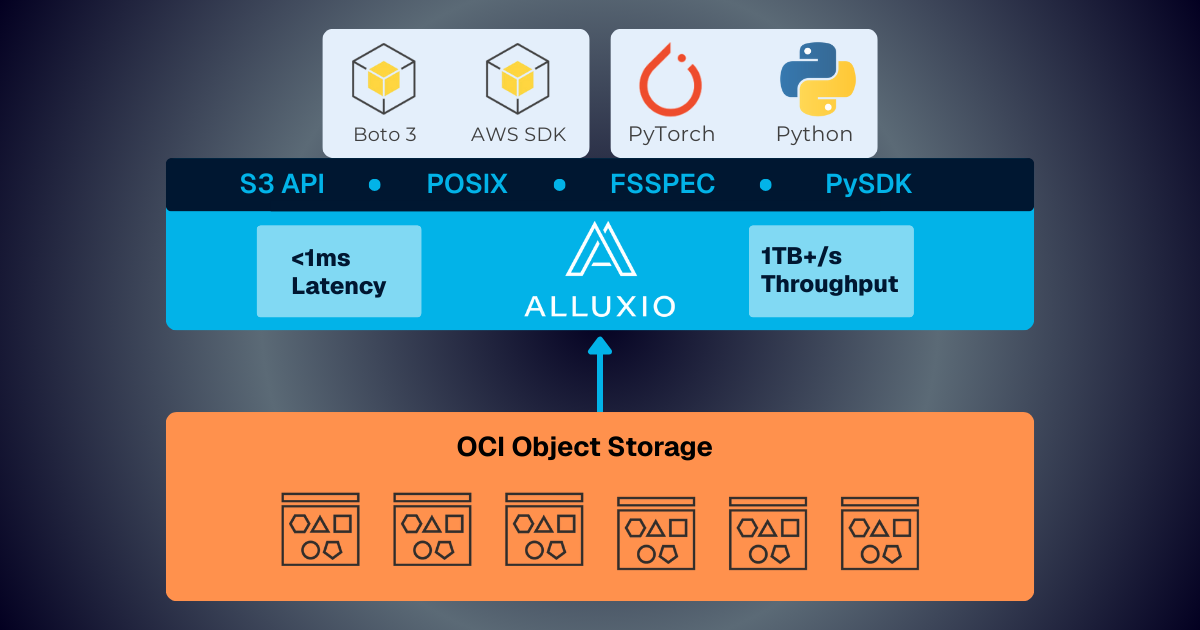
Oracle Cloud Infrastructure has published a technical solution blog demonstrating how Alluxio on Oracle Cloud Infrastructure (OCI) delivers exceptional performance for AI and machine learning workloads, achieving sub-millisecond average latency, near-linear scalability, and over 90% GPU utilization across 350 accelerators.

If you’re building large-scale AI, you’re already multi-cloud by choice (to avoid lock-in) or by necessity (to access scarce GPU capacity). Teams frequently chase capacity bursts, “we need 1,000 GPUs for eight weeks,” across whichever regions or providers can deliver. What slows you down isn’t GPUs, it’s data. Simply accessing the data needed to train, deploy, and serve AI models at the speed and scale required – wherever AI workloads and GPUs are deployed – is in fact not simple at all. In this article, learn how Alluxio brings Simplicity, Speed, and Scale to Multi-GPU Cloud deployments.

.png)
.jpeg)
.jpeg)


.jpeg)
Modern analytics projects rely on a hodgepodge of compute clusters, data stores, and pipelines, flung across countries and continents. Enterprises struggle to meet performance SLAs without replicating lots of data or moving and re-coding applications.
.jpeg)
.jpeg)
The problem with data modernization initiatives is that they result in distributed datasets that impede analytics projects. As enterprises start their cloud migration journey, adopt new types of applications, data stores, and infrastructure, they still leave residual data in the original location. This results in far-flung silos that can be slow, complex and expensive to analyze. As business demands for analytics rise—along with cloud costs—enterprises need to rationalize how they access and process distributed data. They cannot afford to replicate entire datasets or rewrite software every time they study data in more than one location.
.jpeg)
.jpeg)