The Checkpoint Tax Nobody Talks About
Every AI infrastructure team knows the feeling: a training run is humming along, loss is trending in the right direction, GPU utilization looks healthy — and then, periodically, everything stalls. The culprit is almost always a checkpoint write.
Checkpointing is non-negotiable at scale. When hardware fails — and at the scale of thousands of GPUs, it will — your team needs to restart from a known-good state, not from scratch. Jensen Huang put it plainly: "We checkpoint and restart as often as we can." At Meta's Llama 3 training, hardware failures occurred roughly every three hours. Frequent checkpointing wasn't a best practice — it was the primary defense against losing hours of irreplaceable compute.
But here's what most teams underestimate: checkpointing isn't free. Every checkpoint event is a tax on the resource that determines how fast your team can move.
Why Object Storage Is the Wrong Tool for Checkpoint Writes
Most AI training infrastructure stores model artifacts in cloud object storage — S3, GCS, Azure Blob. That's the right choice for persistence. Object storage is durable, cheap, and universally accessible. But it wasn't designed for checkpoint writes.
A standard S3 PUT operation incurs 30 to 40 ms of latency per request. For a single sequential write, that's negligible. For a distributed training job, it's a different story. In FSDP training, every GPU process writes its shard simultaneously — creating massive write concurrency across hundreds or thousands of ranks. At 30–40 ms per request, every rank waits. Every GPU sits idle.
And that's just the baseline. When burst traffic from hundreds of training ranks writing simultaneously hits your S3 bucket, rate limits kick in. S3 returns HTTP 503 errors. Clients retry. Retries add seconds of stall across every GPU in the affected job. In the worst case, sustained throttling causes checkpoint writes to fail entirely — triggering full job restarts and destroying hours of training progress in a single event.
The numbers compound quickly. Consider a platform running 200 concurrent training jobs, each on a 64-GPU cluster. At 35 ms of baseline S3 write latency and 144 checkpoint events per job per day, that's approximately 18 GPU-hours of wasted capacity from baseline latency alone — before a single throttling event or job restart.
A Silent Problem With Compounding Costs
What makes checkpoint overhead particularly dangerous is how invisible it is. No alarm fires. The GPU utilization dashboard looks healthy. Training loss curves look normal. But the capacity that should be advancing your next model iteration is quietly bleeding away on every checkpoint cycle.
The impact manifests in three distinct ways that affect teams differently:
The synchronous stall is constant and invisible — capacity eroding silently on every checkpoint cycle, across every job, every day. The throttling retries are intermittent and disruptive — unpredictable latency spikes that make training timelines unreliable and frustrate engineers trying to hit model delivery deadlines. The full job restarts are catastrophic — they force engineers to stop, triage, restart, and re-evaluate training progress. At scale, repeated checkpoint failures don't just waste GPU time; they erode team confidence in the infrastructure.
The checkpoint problem also grows nonlinearly with model size. Checkpoint sizes are consistently larger than teams expect. The optimizer state multiplier — approximately 4x over weights alone, due to Adam-class optimizers storing per-parameter first and second moment estimates — means that for trillion-parameter-scale models, a single checkpoint event can generate 15 TB or more of write traffic. The larger the model, the more painful the write, and the more frequently you need to write it.

There Are Architectural Solutions — But They're Not All Equivalent
The good news is that checkpoint latency is an architectural problem, and architectural problems have architectural solutions. The bad news is that not all solutions are equivalent, and picking the wrong one for your environment creates new operational headaches.
Async checkpointing libraries can overlap write I/O with training, but they don't address the underlying S3 latency problem — they shift it. Local NVMe staging is fast but introduces recovery complexity and doesn't travel well across clouds. RAM-based staging offers near-instant writes but is vulnerable to host-level failures. Distributed checkpoint stores add operational overhead and vendor lock-in. Each approach makes sense in certain scenarios and fails in others.
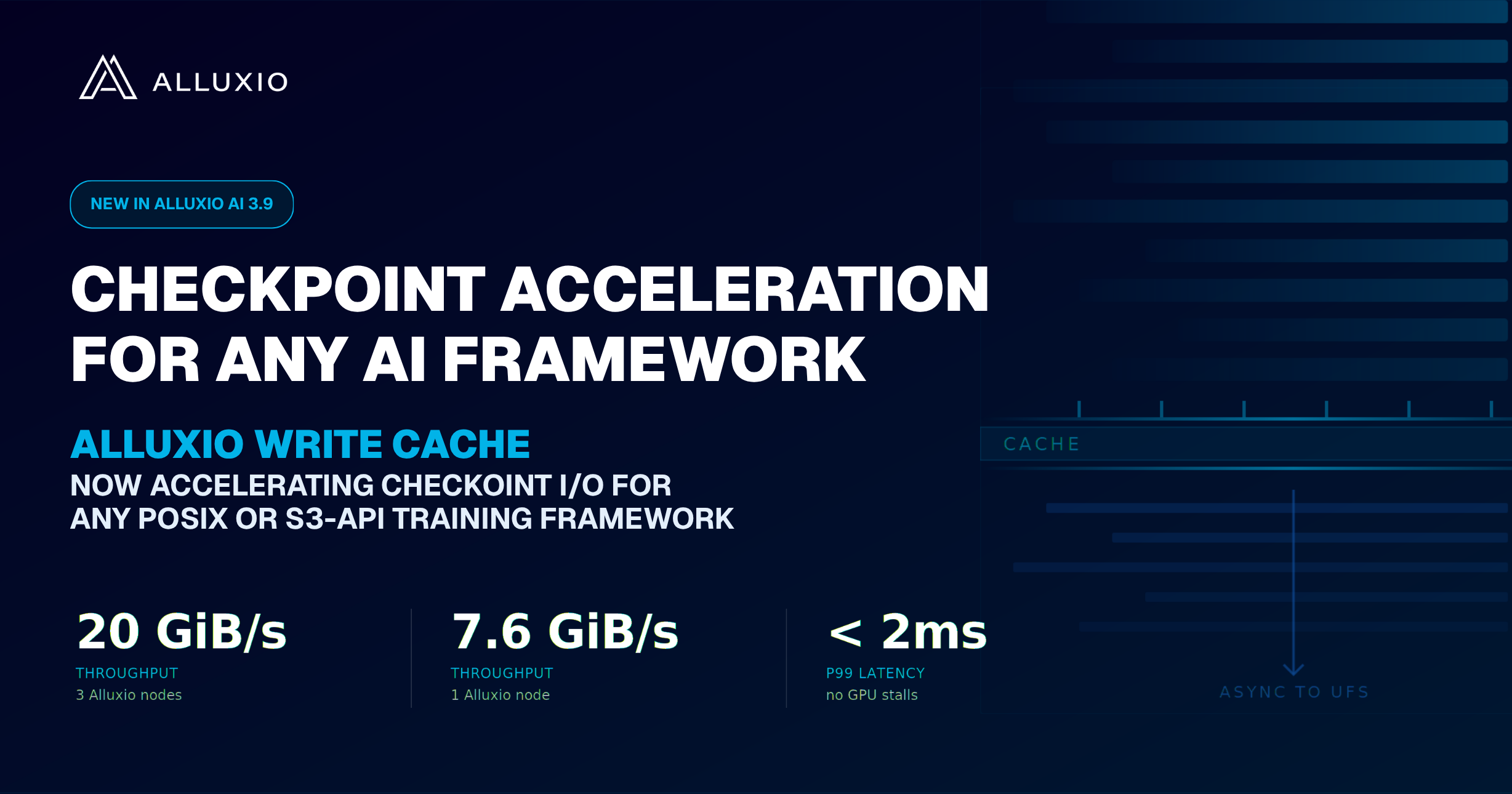
Write-back caching takes a different approach: absorb checkpoint writes into a fast local cache tier, acknowledge the write to the training process immediately, and drain to object storage asynchronously in the background. The training job sees near-instant write completion. Object storage remains the system of record. And the architecture is portable — it works the same way whether you're running on AWS, GCP, a GPU cloud provider, or on-premises.
Go Deeper: The Full Architecture Guide
The above is a summary of a problem that deserves a full technical treatment. Alluxio's Checkpointing for Large-Scale AI Training guide covers the complete picture: the root causes of checkpoint-induced GPU idle time, a comprehensive survey of every major checkpoint architecture with scenario-based guidance on where each fits, and a detailed technical description of how write-back caching works in production — including how Alluxio Write Cache implements it across multi-cloud and hybrid environments.
If your team is responsible for distributed training infrastructure — whether you're running a shared platform across hundreds of concurrent jobs or building for a single large training run — this guide is written for you.
Get the full guide: Checkpoint Acceleration for Large-Scale AI Training
.png)
Blog

Alluxio’s MLPerf Storage v3.0 results demonstrate that organizations can keep persistent AI data in Amazon S3 while delivering high-performance training and checkpointing through a distributed cache close to compute. Alluxio achieved 147.03 GiB/s checkpoint write bandwidth for Llama 3 405B and near-linear scaling from one to 32 workers.